Monday, January 19, 2015

Happy New Year 2015

I didn't write for all of 2014 because it was a year of blessings and a year of suffering. Living between those two extremes, feeling conflicted and confused about the world, what does one have to say? And so 2015 begins with an end to 2014's suffering, Mom died on January 6th. My happy, beautiful, funny, sweet mother. We left her in Rehovot Cemetary during the sandstorm, hours before the big winter rains came in. Her year of battling cancer is over, and though I imagine she's in a better place now, her absence leaves me alone with just questions and memories.
I'm not ready to eulogize her yet. Rather, as time goes on, I find myself more and more speechless. How could she have been taken away? What do we learn from illness, from death, from losing a loved one, from a world that is less one big, beautiful, amazing soul? I don't have answers, I just have my memories of a perfect mother, and a heroic woman who I can only strive to emulate.
But then there are the practicalities. I really miss her. I wish I could pick up my phone and call her like I used to every day. I wish she'd come and walk to the park with me and the kids. I wish she'd teach me how to make strudel. I wish we could have tried playing golf again together, ridiculous and giggly as we were that day. I wish I wish I wish.

And then the blessings. A baby girl born in July. A little lovebug kind of baby who loves her cheeks to be kissed and to be held close while I do everything. She looks adoringly at her big sister who loves her with a full and open heart. They make each other laugh, and I am so glad that they have one other. Every girl needs a sister. That's what Mom used to say. She gave me two.


Tuesday, July 30, 2013

Gatekeepers and being welcomed

Today in the middle of Hebrew class, I started to think about my life here and my aliyah experience. A momentary space-out in the midst of an introduction to a new verb form, unfortunately. For the first year, things were difficult. Logistically difficult, that is. Getting bank accounts, registering with the health system, the types of things that require standing in long lines in government offices. The rest of that time was a slideshow of new and interesting experiences: ulpan, traveling throughout the country, learning how to drive amongst Israeli drivers, grocery shopping at the shuk, and making new friends.

I'm now in the middle of my second year in Israel. The newness has worn away, and I feel that despite my stumbling in the language, I am here standing on two feet and ready to move forward and to give back to Israeli society. What I'd really like to do is make a living on my own, to create, and to build something in Israel that will provide for more than just myself. To build a business that does good for the world.

Four years ago I started a business in San Francisco. It's an ecommerce business, a fairly simple buy low-sell high model with a socially conscious slant. In Israel, this particular type of business requires a license. Last week, I put together everything I needed to attain the license - bank account information, letters of recommendation, a letter from my lawyer, a letter from my accountant, my resume, a cover letter, copies of every form of identification I've ever had, my soul. When I arrived to submit my application, despite having been welcomed to the government office in the past, I was greeted with apparent disdain. Perhaps they heard that my business was small, much smaller than the other hundred-year-old businesses under their authority. Perhaps they're not used to young women starting businesses. Perhaps they're just not friendly, afraid I could create more work for them. I could continue to guess, but it's useless.

Rather than detail the whole of my experience, suffice it to say that it was demoralizing and demotivating. The inspiration dripped out from me as I wandered slowly to my car in the midday summer heat. My application had been rejected by a young office worker who needed additional documentation. Documentation that would be impossible for a startup to attain without significant funding. An hour drive in traffic to get there, 60 shekels for parking, and an hour drive back home.

So where do I go from here? I feel lost and a bit stuck. Do I continue to move forward, to attempt to get everything together so that I can get this license, be under the scrutiny of an unkind government office, and pay ungodly amounts of money just to maintain the license. Do I hire someone in the US to run the business from there, while I manage from here? Or do I change completely? Start something new, something more creative but related to what I was doing. Something that doesn't require a tremendous amount of oversight and out-of-pocket expenses to get started.

It's very hard to make a decision like this when it's tied so closely to me. It's a concept I've spent the last few years perfecting, building a client base, creating lasting relationships with wonderful organizations that are doing amazing things for the world. It's a business that I have built from the ground up that I'm very proud of - even if we aren't selling a million dollars worth of product every year ... yet! It may very well be the only concrete thing, aside from my daughter, that I've created and placed in the world.

So back to my thoughts in class. I'm new to this country, but I am a proud citizen. I want to give back much more than I take. Like learning Hebrew, nothing comes so easy here. It seems to take time, plenty of persistence, and the ability to weather embarrassment. But, someday, I plan to be fluent and established here. And when that day comes, I want to be someone that others can approach, who can inspire and help others achieve their dreams here. And perhaps this little bit of kindness and welcoming that I bring to the world will trickle down and affect the other gatekeepers of opportunity.

A lofty couple of goals and a lack of direction today. I spaced back into class and tried to participate. The teacher asked, 'what other verbs can you think of in this format?' I raised my hand and answered incorrectly. The teacher wrote my verb on the board, turned to the class, said the verb, turned back around and wrote a big 'X' over it. The exed-out verb remained there on the board for the rest of class. Yet another shaming, but I can take it. And if I can learn from this, then I will learn from the rest. Someday I will be fluent. Someday I will give back even more.

Wednesday, May 29, 2013

Har Ha Tayasim | The Pilot's Mountain


For my birthday this past Sunday, we decided to take a hike. We had no idea where to go, and unlike San Francisco where I'd just log onto bahiker.com and find a suitable hike, we had nothing to go by but a trail map of the Jerusalem Forest. So, we found a park in the forest that looked nice, and went. The park was called Har Ha Tayasim, which means "The Pilot's Mountain." We also decided we have to write down where we hike so that we and others can enjoy an English language online guide to nice hikes in Israel.

The mountain is located a thirty minute drive outside of Jerusalem, just past Kibbutz Tsuba on 395. The ride is gorgeous, with sweeping views and cliffs on either side. At the mountain, you can first drive over to a lookout that has an incredible view of the Jerusalem forest and surrounding area, and a nice tree to sit under for a picnic lunch.

There is a groomed park area with walkways made out of Jerusalem stone, a few benches, some shade, and a memorial to the fallen pilots in the War of Independence. We had lunch on the benches in the park because the clean ground was perfect for a baby crawling at our feet.

From the park, you can descend into the valley below via two different trails. One, the blue trail, leads you along a winding dirt road. The other, the black trail, leads you on a steep, narrow path directly down the mountain. Both end up at the base where there is an ancient, well-kept spring and ruins of an overlooking stone home. The area by the spring has flat, grassy fields - another good place for a rest or a picnic.

We took the black trail, and it was really fun. Be forewarned that there is a lot of climbing up and down rock faces. We joked that the trail was a 4.8 in climber's terms. We did it with a baby on our back, so it's not that difficult, but be prepared with the right type of shoes. The blue trail is much easier, but doesn't have the shade and the surrounding greenery that you get on the black trail. Not sure exactly how long the trail was because it went straight down, but probably about a mile down and a mile back up. It took us about a little over an hour round trip.

Next time we hike, I'll remember to take some photos.


Wednesday, April 3, 2013

Last minute oatmeal cookies

We host a shiur in our home on Wednesday nights at 8:30pm. Everyone sits on the couches surrounding a coffee table where I usually put out an assortment of snacks - dried fruits, nuts, and always some type of freshly baked good. Today I spent most of my usual time in the kitchen reorganizing and putting the non-Pesach dishes back in their ordinary places. No time for baking, until the very last minute ...

Exactly 15 minutes before the shiur, I decided to make oatmeal cookies despite the fact that we were missing pretty much every key ingredient in all the oatmeal recipes I found online in those last few seconds. Butter, flour, eggs, baking powder, to name a few of my missing ingredients. I figured worst-case scenario they'd turn out like granola. So, I pulled out the ingredients we had, and decided I'd just wing it. Surprisingly, they were delicious. And also ... egg-free, sugar-free, nut-free, gluten-free.

Ingredients:
3.5 cups thick cut oats (chopped in food processor for 60 seconds)
2 tablespoons silan (date honey - could also substitute real honey)
1 tsp baking soda
1/2 tsp salt
3 tsp cinnamon
2 tsp vanilla extract
1-2 tbsp hazelnut oil (other oils work too)
6 oz raw applesauce
1 cup raisins
1/4 tsp xantham gum

Preheat oven to 400 degrees. Mix the oats, baking soda, salt, cinnamon, and vanilla together. Then add silan, oil, applesauce and xantham gum. Add more oil if necessary to get a flaky consistency. Add the raisins. Stir to combine. Roll about a tablespoon of dough between hands and place in muffin tins or on a baking sheet. Bake for 15 mins.

Bon appetit!


Tuesday, January 1, 2013

Orange

It wasn't until I moved to Israel that I realized why the Jewish new year is in the fall. Israel, like California, dries up during the hot, rainless summer. The hills turn brown, the plants wither into mangled, leafless bushes, and the earth is grey and dusty. When September comes along, the weather dips just enough to grace the High Holidays with comfortable weather. The cool night wind clears the skies, and makes a dinner outside on the porch finally doable. It's the time of year that inspires us to rummage through our closets for cardigan sweaters and light jackets.

One month after Rosh Hashanah, just as we say the prayer for rain, like heavenly clockwork, the sky opens up and releases its first downfall. The first rains of the year are cool rains that make the steam rise from the heat-locked pavement and the hills pop green grass. The mangled bushes begin to sprout while the small, imported oak trees that line city streets finally decide to drop their yellow-brown leaves onto wet sidewalks. The oak leaves are our only sign of a traditional autumn.

Meanwhile in the States, you know how it goes, the maple trees turn all sorts of beautiful colors while smoke rises from chimneys gracing neighborhoods with that yummy, burnt fragrance. So many leaves fall in so many colors that raking them from the yard becomes an exercise in organizing a Jackson Pollack. The pumpkin picking, the hay rides, the chilly fingers, the steam that billows from your mouth, these are the things that I crave every year when November rolls around. A craving that is rarely satisfied.

I love fall, or at least I love what I remember of fall. Every year my body waits for it to come, and it never does. Living in California and the Middle East will do that to you. The space that was once autumn felt suddenly filled when I had Eliana. With the baby and a wonderful husband, I finally felt complete. In the days after her birth, I considered pushing to name her Stav, which means autumn in Hebrew. She was born in August, and is a peaches-and-cream spring-colored baby. Obviously, the completeness that her existence gave me had nothing to do with fall. Stav is still a pretty name, though.

Instead of reclaiming autumn with my daughter's name, I've resorted to reclaiming autumn with flavors. In California I made roasted kabocha squash and pumpkin curries, in Israel I've turned toward butternut squash. Roasted, pureed, mashed, stuffed, stuffed into other things, stewed, and stir-fried, butternut squash has become my silkier, sweeter replacement for that quintessential fall gourde - the pumpkin. From October through December, at least one dish of every meal I eat is a bright, firey, delicious orange color. Autumn on a plate.

On the Friday afternoon before Thanksgiving this year, I cut a butternut squash in half, scooped out the seeds, placed the sides face down on a cooking sheet in a 400 degree oven. I cooked it until the skin bubbled and crackled. I stuffed it with a mixture of millet, sauteed zucchini, apple, fennel, a touch of honey and a few spices. I finished it off with a sprinkling of breadcrumbs and pumpkin seeds, and placed it back in the warm oven so that we could eat it a few hours later for Shabbat dinner.

Eliana had been outside of herself for the whole afternoon, crying and carrying on. We wrapped her up tightly and placed her feisty little body into the bassinette, preparing to take her to synagogue with us just up the street. I put on a black pencil skirt, a tan cardigan, a light belted jacket and a pair of smart, knee length black boots, and we started up the street with our baby girl finally calming down in her stroller. The autumn sky at sunset in Jerusalem is a white-gold color with orange and pink streaks, and the sky that particular evening was perfectly exemplary of its royal evening flush.

About a quarter mile up the road, next to a large construction site, Eliana's eyes finally became heavy, and as peace settled upon our family, we smiled at one another. Another week coming to a peaceful end. At just that very moment, our peace was disrupted.

The sirens began to blast. The eery wail warned us to take cover. Something coming within 60 seconds. Something from the sky. wwwaaaaAAAAAAAaaaaa wwwwaaaaAAAAAaaaaaaa.

For the last five days, hundreds of rockets were fired from Gaza at places like Tel Aviv, Ashdod, Ashkelon, and other coastal cities. Sirens constantly blared in those cities, but in far away, inland Jerusalem, the sirens never went off except for annual drills and for Holocaust Remembrance Day.


In that moment, knowing that something was about to fall from the sky, I remembered East Coast thunderstorms. A sudden clap of thunder, forewarning that lightning was coming closer, where it would hit, nobody knew. I was terrified of thunderstorms, and as soon as I heard thunder, ran for cover in our cool, dark basement.

That evening in November, my instincts took hold of me and in my cute black boots, began to book it back to our apartment. My husband grabbed my arm and pulled us by a pile of bricks from the construction site. He positioned Eliana's stroller just behind us, her eyes facing the sky, and we waited. Her stroller no longer moving, she began to cry.

Five, four, three, two, one. BOOM BOOM fffwwwoooooooossssshhhhhhhhhhh. Alllaaaahhhhhhuu Aqbar!!!!!

The rockets were perfectly timed to land just before the Muslim call to prayer. Jerusalem is surrounded by minarets outfitted with loudspeakers and bright green lights. As the cacophony of the dozens of muezzins took over the airspace, we stood up from our corner behind the bricks, and hastened back to the apartment with a hysterical baby. No synagogue tonight.

That night, over stuffed butternut squash, we guessed where the rockets landed, and where they could have possibly been fired from. No ambulance sirens was a good sign not to be nervous, and the conversation quickly turned away from the war. As always, a peaceful Shabbat followed.

The next night we learned that the rockets had, in fact, been fired from Gaza. They landed in an open space next to an Arab village in the West Bank, near Jerusalem.

War was always something that happened far away. Something I could ignore while I paid more attention to things a little closer to home - what I was going to eat at the next meal, whether or not I was going to the gym that day, what my friends were posting on Facebook. Now that Operation Pillar of Defense is long over, the civil war in Syria continues on with dozens of casualties every single day. War is in my backyard, and all my Facebook friends are posting about Stanford winning the Rose Bowl and their New Years resolutions.

If it's close to me, it's close to you. Let's make a new type of resolution this year. Let's resolve to be aware of what's going on in the world and to advocate peace. Peace between each other, and peace between people we don't even know. It's what most of us want anyway, right? Who really wants to wage war but a few power-hungry bureaucrats. The rest of us are the same - dreaming of autumn, spending time with our families, and enjoying the company of one another during our little bits of time on earth.


Monday, July 9, 2012

Pregnant in Jerusalem

I'm 36 weeks and 5 days pregnant. Aside from not being able to run much, not having a flat belly, and not being able to wear my favorite jeans, I feel pretty much like the same person I was nine months ago. The fear of taking care of a baby is overshadowed by the impending doom of labor and a two-night stay in a foreign hospital.

In fact, it's not really the labor part that scares me. It's the foreign part. And really, it shouldn't scare me at all. I've been pregnant in a foreign country for nine months already. Practically all I know of life in Israel comes from a pregnant perspective. So now I'll share that perspective with you.

Starting with my expectations. When an American woman gets pregnant, she thinks about a few things that will happen during her pregnancy - friends getting really excited for her, a baby shower, fun prenatal clothing shopping at various specialty stores, putting the nursery together, strangers politely not saying anything about her growing belly, and a simple birth with an epidural and a tv monitor overhead running the latest movies. This is how I thought it would all go.

Here's how it actually went. First trimester doesn't count because I spent most of it inside, eating plain crackers, and lying on my couch. When the second trimester came, I popped pretty quick. With the baby belly in plain view, I would go to friends' houses for dinners and they would politely pretend they didn't notice the bump and offer me wine. Like a rehearsed dance, I'd politely refuse the wine and thank them, asking for juice instead. Still no comment.

Though I was done with the first trimester, I never felt comfortable talking about my pregnancy or relaying the fact that I was pregnant to anyone except close family and a few friends. People have different traditions here regarding pregnancy - some people wait until they're six months pregnant to talk about it with others, others are open about it after the first trimester. Generally, though, people stay pretty mum about the pregnancy until about 5-6 months. The purpose is to avoid the "ayin harah" or the "evil eye."  Same reason that people don't have baby showers before the birth or begin building a nursery in their homes. Everything waits until the baby is here, safely.

And then I reached that 5-6 month mark and all of a sudden the barrage of comments started coming. First my ulpan teacher asked me in front of the entire class if I was open to telling everyone that I was pregnant, because I obviously was. Then my other ulpan teacher incessantly began asking me how I felt. Again, in front of the entire class. People started to get up from their seats for me on the bus. Things were still a little lowkey at this point.

At the end of my sixth month, though, I started to notice a strange phenomenon. Men were commenting on my belly. The first one to do it was the middle-aged Sephardi manager at our local post office. As I dropped a letter into his hands to be mailed to the US, he pointed at my soccer-ball belly and said, "That is beautiful. Really beautiful." I was taken aback, and responded with a quick thanks and mentioned that I thought it was huge. "No, it's beautiful," he said.

For the next couple of months, the only people to comment on my pregnancy were men! Middle-aged men, not old, grandfatherly types. Most wanted to guess the gender or my due date. Some wanted to thank me for adding a child to their nation. Once, when I was looking at an apartment with my husband, the owner of the apartment began a conversation with me by guessing the gender of the baby, then continuing to talk directly and only to me about life, his wonderful memories of San Francisco and his dreams for the future. For about 20 minutes this went on while I was standing holding my husband's hand. Despite my bump and my husband on hand, I honestly think the guy was flirting with me.

After those couple of months, I concluded that men in Israel are fascinated by pregnancy. That they think it's beautiful. This came as a welcome surprise.

Then the eighth and ninth month came along. I carry very forward, so I look like I'm ready to pop. This is when the men stopped commenting, and the women began. Some gently patted my belly while casually walking by, saying something like, "In good time." Others tell me not to worry. One woman at the natural foods market reminded me that I should be practicing for labor. Then she gave me samples of creams I could put on my baby. Other women didn't say anything, but smiled at me reassuringly as I walked past. As if to say, 'don't worry, it's going to be fine.'

This army of women, I feel, sees my impending labor, my impending induction into the world of motherhood. From their angle, they feel a little sorry for me, perhaps a little nervous. It reminds me of high school, when I would run a race, finish it, recover, and then wish the next girls luck before they stepped on the starting line. My stomach would jump with butterflies while I reassured them that if they relaxed and did everything they practiced, they'd be fine.

In the end, I didn't have the baby shower, the friends ooing and ahhing over my belly, the pre-designed nursery, the polite silence of strangers in public, or the assurance that I'd have an epidural and a tv set in the hospital. Instead, I got to follow an ancient tradition of keeping my own secret for as long as I felt comfortable, of not bringing baby stuff into my life before the actual baby arrived, and most importantly, feeling that despite being around strangers, I was still amongst a group of people who genuinely appreciated, respected, and felt excited about my pregnancy, too.

Wednesday, July 4, 2012

Israel and the Continental Divide

At the European Lacrosse Championships in Amsterdam, the Israel team made it to the quarterfinals. The previous game was a huge upset win against Wales. Wales had been ranked 8th as of the year before. Also, it was rumored that Wales led the charge in trying to keep Israel out of the European league. It was a sweet victory.

After that win, I felt so proud of our team and of Israel. They'd really proven themselves and their country, and earned a well-ranked spot in the European league. I sat in the stands for the quarterfinal match between Israel and the Netherlands feeling full of patriotism for my country. They played Hatikvah and I stood and sang the words, then they played Holland's national anthem and I stood for that, too. I was that gloating, pregnant wife.

I spread myself and my lunch out on a bench at the sidelines, hoping that no one would come sit directly next to me so I could stretch out if my back started to hurt. There were plenty of benches and seating when the game began. After the first quarter, though, the area was full of screaming orange-clad fans. The spot that my cheese sandwich filled was the last resting place available. Soon enough, a very tall, very Dutch sixty-something mother came and pushed it aside, replacing it with her derrier. "I hope you don't mind," she said after affixing her seated position so that we were thigh-to-thigh.

On its home turf with a throng of fans dressed in electric orange, the Netherlands played extremely well. They were an excellent team, and as I watched them play, it was obvious that they had the full package - a great offense, a great defense, and a great goalie. To be fair, the Israeli team had only been playing with one another for a few weeks prior to the tournament. Israel trailed behind, but managed to score a few goals.

Somewhere in the third quarter when the score was about 12-3, the Dutch woman on my thigh turned to me and said, "Can you please tell me why Israel is in the European league?" I responded that Israel and much of the Middle East is on the continental divide. That it's sort of like Russia - part Europe, part Asia. She looked at me aghast. "I certainly never heard that. Tell me, why isn't Israel part of the EU then?"

At this point, I probably should have pointed out that Switzerland isn't in the EU either, though no one seems to question its position as a European country. Rather, I shrugged, and let the Jewish grandmother on the neighboring bench chime in, "No, Israel isn't part of the EU because it can manage its own economy quite well." End of conversation.

I saw the lady pointing at me while talking to other Dutch parents from afar a few times after the game was over. I didn't completely know if my answer had been correct yet, but frankly, I thought it totally inappropriate of her to ask me, an obvious Israel fan, such a question after Israel had been successfully participating in the tournament for the previous ten days. In fact, I was offended by it. Of course we're part of the European league. And while I'm at it, yes we're a country, and no matter how many goals your son's lacrosse team scores on us, we're not going anywhere.

I looked it up a few days later. Apparently Israel isn't on the continental divide between Europe, Asia and Africa. Though it's very close to being so. Geographically, Israel is located in Asia. Socially, Israel is considered part of Europe. So, when it comes to sports, Israel is included in European leagues and tournaments.

Does this mean I eat my words and that the woman was right to question? Or, does it still mean that despite all of that, the woman should have never asked me. That the asking of the question was one of those anti-Zionist inspired moments? I guess I'll never know, but something still doesn't sit right with me about it. To be honest, I think her motivation might have stemmed from a little bit of both.

Saturday, June 30, 2012

Traveling and then going home

To me, the best traveler is the person who can go anywhere and ensconce themselves so deeply into their surroundings that they can easily imagine settling down and living in the alien land. That person was me. Until about two days ago. Everywhere I went, I hung on to every detail of the foreign life I could live there. Imagining myself waking up in the mornings, walking down the picturesque streets, catching the various forms of public transportation to my job, lunching at the local cafes, partying with friends at the city/town/village's expansive nightlife, and taking day trips to the sites that dotted the outskirts of wherever I happened to be.

This yearning to live wherever I happened to travel brought me to live in some of the most interesting and exciting places in the world - Shanghai, Beijing, San Francisco, Jerusalem. Over time, though, the feeling of needing to live where I wasn't began to make me feel extremely unsettled. I imagined life in Kauai, Portland, Boulder, Burlington, Berlin, Charlottesville, New Orleans, and essentially anywhere I traveled. Returning home to wherever I happened to be living at the time brought with it a feeling of unease for giving up on an exciting new life full of possibility.


I spent the last ten days Amsterdam, a city touted as one of the most open, diverse, and sophisticated cities in Europe. Its streets are clean, historic, and lined with the most elegant sites - canals, houseboats, handsome multistory row houses, open-air cafes, tall blondes on bikes, flower shops, and museums galore. The city has a vibe of calm prosperity and order. It's the type of city that would have me endlessly daydreaming of my life as a Dutch resident as I wandered Amsterdam's streets for those ten long days.

But something was different this time. I managed to observe Amsterdam as a settled outsider. I enjoyed everything as a passerby might, knowing that the ten days would soon end. I had the things I wanted to do, the places I wanted to go, the delicacies I wanted to eat all lined up and went through them one by one. Visiting the Van Gogh Museum, getting lost in the Jordaan, dipping a fresh croissant in steamy hot chocolate, and riding a tour boat along the canals were among some of the
 highlights. And as the time wore on and the trip began to come to a close, I longed for Israel again.

I missed the shuk, the streets teeming with emotionally charged people from all over the world, our Prius, our beautiful spacious apartment, the cool evening breeze, the pool up the street, the feeling of being amongst family, the idea that simply living where I'm living has a meaning of its own. Essentially, I missed home.

Returning to Israel with a renewed sense of respect for where I live and what I'm doing here was the most valuable experience of this trip to the Netherlands. Back at home on my couch, sipping homemade hot chocolate, overlooking the wide valley that snakes beyond our veranda, through the hills and off to the Dead Sea, I feel very much at peace. 

Tuesday, June 19, 2012

Amsterdamse Bos

Here I am writing from just outside Amsterdam, in a small town surrounded by forest, rivers and marshy canals. I'm staying in a "camping" resort, which essentially means that our room is a self-standing cabin structure with its own bathroom, kitchen, sitting room, television, and wide array of Ikea-manufactured furniture. I prepared lunch with the windows open to temper the heat from the stove with the cool, moist air from outside. As I write, I'm surrounded by the sumptuous smells of fried onions and wet grass. A choral of birds is my background music, the songs occasionally muffled by the roar of an airplane flying overhead. The campground is not far from the airport.

I'm in the Netherlands because my husband is on the Israel National Lacrosse team, and the European championships are taking place this week. So far they're just starting with scrimmages against the teams that they will play when the tournament officially starts tomorrow. Yesterday was the Netherlands, today is Ireland. The team is made up of a mix of American-born olim chadashim and Israelis who are now living in the US. After this tournament, the team returns to the US to spend the summer introducing the sport to students across Israel through training sessions and clinics.

As an observer, watching the Israel lacrosse team play makes me feel more patriotic than I felt at the height of my aliyah process. Seeing the team cheer "Am Yisrael Chai" before games, admiring their myriad of Zionist and Jewish tattoos, hearing them yell to one another on the field in Hebrew, and watching them stand up bravely against the gargantuan, aggressive players on teams like the Netherlands.


The most amazing part of all of this is that here in the Netherlands the Israel team will parade in their striking blue and white uniforms with pride for the next ten days, and they will do extremely well in this tournament. The Netherlands gave up more of their Jewish population to the Nazis during the Holocaust than any other nation in Europe. Only one in sixteen Jews survived. Here we are again, and now with our own country to represent and to return safely to.


This trip reminds me of why I made aliyah in the first place, and it reminds me how lucky I am to live in such a special country.

Monday, June 11, 2012

Arsonists in my Neighborhood

I was enjoying a calm evening in the apartment, checking email and eating dinner when I noticed flashing lights outside our window. I thought little of it, since it seemed from the corner of my eye just a traffic jam. I continued my meal until I began to notice the rapidly familiarizing scent of burning brush. I looked outside once again, and at the base of the wadi, across the street from a row of town houses, an enormous fire blazed in the wheat-colored grass.

A fire engine had already pulled up next to the fire, and several men appeared to be spraying the fire down with hoses. I assumed they'd put the fire out quickly, so I went back to the computer. About fifteen minutes later, I looked up and the sky was full of smoke, and from behind the houses around the corner, I could see the blaze flickering and a new brown-colored smoke rising as well.

This is one of those times I wish I had thought of taking a picture ...

We've been having a little trouble with fires in our neighborhood over the last week. Last Saturday a fire caused 30 homes to be evacuated up the street from our apartment. Little damage was done, except for three cars that were completely consumed. There have been several more brush fires in the wadi as well.

On my walk the other day, I just so happened to notice charred trees and a half-burned dumpster still full of detritus that spilled out onto the streets over the strings of melted green plastic.

The fires are supposedly being caused by arsonists, and supposedly the arsonists are teenagers from a neighboring Arab village. I guess it's been a few too many fires to continue to believe that people are accidentally throwing their cigarette butts in poorly chosen places. Needless to say, this seems like one of my many initiations into the conflict part of the Israeli experience.

Sunday, May 27, 2012

Illegal Immigrants in Israel

So, there's a lot going on around the internet these days about the violent protests against the Sudanese and Eritrean refugees in South Tel Aviv. Before I say anything, violent protests against anyone or any group of people are inappropriate, and this particular aspect of the African immigration issue represents an embarrassment to Israel. Simple as that.

All that said, I'd like to add a few more dimensions to the story that are rarely written about in the news that are circulating in places like Facebook, Twitter, and other social media outlets. For what reason, I have no idea.


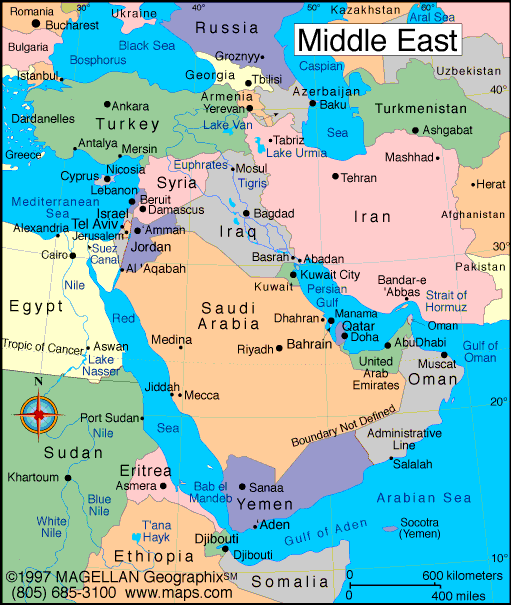
Israel is a tiny country the size of Rhode Island surrounded on all sides by much larger countries - Egypt, Saudi Arabia, Jordan, Syria, to name a few. I suggest everyone take a look at a map because the amount of press coverage Israel gets makes it seem as if its size dwarfs these other countries. Each of these other countries is Muslim, contains an incredible amount of land mass, and many of them are closer to Sudan and Eritrea than Israel. In fact, the Africans have to cross all the way through Egypt and the Sinai in order to get to Israel. So why don't they just cross the border of their home country and become refugees in Egypt?

Because in Egypt they will get killed, they will be treated poorly, or they will have little or no work prospects. Check this out: The influx of Africans to Israel began in 2005 after the Egyptian police attacked Sudanese refugees who were camped out in Cairo and demanded asylum. More than 20 people were killed, and word spread that Israel would provide them a better welcome and more job opportunities.

Essentially, the Sudanese are moving to Israel because, according to one of the first Sudanese to cross the border from Egypt to Israel, "In Israel Sudanese can earn $4 per hour. In Egypt such a wage is unheard of. Moreover, medical care and educational opportunities are far better in Israel than in Egypt."

Like all of us, the African migrants are seeking a better lot in life. But, when it comes to Israel, they're doing it illegally. The vast majority of Sudanese migrants in Israel do not have refugee status - they are simply considered illegal immigrants.  Why? Because Sudan is a "hostile state" to Israel, and for obvious reasons, accepting a large influx of their population could create a dangerous situation domestically within the State of Israel.

Despite the fact that these migrants are not labeled as refugees, over the past ten years, Israel has accepted approximately 200,000 Sudanese migrants, and is officially housing 15,000 of them in centers through the country. Most of the migrants are living in South Tel Aviv. They are allowed to work in Israel, and employers are not fined for employing illegal Sudanese migrants. Last time I checked, you can't hire an illegal immigrant in the United States...

Last thing I'd like to mention is the hullaballoo over Israel building a fence to slow the flow of migrants entering the country from Egypt's Sinai. Let's first consider that the United States has done the exact same thing. Let's also consider that preventing massive influx of illegal immigrants into any country is a priority of national security, particularly if those illegal immigrants are arriving from an "enemy state."

Like I said before, the protests were inappropriate. The best way to deal with an issue like this is through political process. Citizens must begin to make their feelings known to politicians, and the politicians must take it upon themselves to devise a plan to give the best treatment possible to migrants who have already arrived in Israel and to curb future migration to Israel in a responsible way. Fueling hatred and anger against a group of people will only increase the likelihood of domestic problems in the future.

Thursday, April 26, 2012

Culture Shock

This is what home life looks like these days ...

And for the most part, that's where I am when I'm at home, unless I'm sitting at the couch with my MacBook Pro. It's almost pure normalcy here - same as life was in China, San Francisco, or even Richmond, Virginia. In between the lines, though, are moments of difference and change.

For five days every week, I go to an intensive Hebrew language course for new immigrants called "ulpan." The course lasts for five hours, starting at 8:30am. My class of 20 is made up of men and women between the ages of 22 and 35 from Russia, Kazakhstan, Belarus, France, Spain, Chile, the UK, the US, and Canada. At the 10:30am break, I eat an apple, sit on the deck outside and talk to my three close friends - all who hail from the UK. I never see these friends outside of the course.

After classes, I head home and do what you see up in the photo - stand in the kitchen and make lunch. Then I eat together with Jack. This is the best and most normal part of the day.

The rest of the day is consumed by errands amongst non-English speakers - and my Hebrew is simply not there yet, navigating the most insane traffic I have ever experienced, or exercising at our lovely gym that just so happens to be entertainingly full of retirees playing backgammon or boiling their rotund bellies in a hot tub that faces the entrance.

I go between laughing at, ignoring and being frustrated by the differences in my life. It's very difficult to move to a new place, and though I thought I was immune to experiencing culture shock after having lived in China so many times, I'm remain simply human.

I realize in going over this blog that I have written from when I lived in San Francisco right out of college to China after that, back to San Francisco, and now to Israel. Is this a blog about living life to its fullest or is this a blog about experiencing differences and new cultures? I'm starting to think it's about the latter...


Sunday, April 15, 2012

The View


From the balcony, the view of the valley below was mesmerizing. At first a gentle slope with olive trees, it descended deeper with near vertical walls studded with ancient caves and part of a recently recovered aqueduct, and eventually it flattened out into a rocky wadi that led into the Arab village beyond. Five times a day, the devoted singsong of the muezzin echoed up the wadi, snaked its way through the valley, and slipped through the sliding glass doors into the living room, the kitchen, and the bedroom. The sound had become so familiar in the house that the old armchair seemed to have developed a slight indentation where the voice settled on its many visits. 

Wednesday, February 8, 2012

The Raw Stone

My new website has finally launched! I am so excited. I worked with an amazing design team to get this up and running and now it's here. Ethical, rough and cut gemstones from the best places in the world.

www.therawstone.com


Monday, January 9, 2012

Fresh Local Strawberries in January

A pleasant surprise in the dead of the Jerusalem winter is the sweet, abundant, candy-colored strawberries. Israel has two strawberry seasons every year - one in summer, one in winter. The double harvest doesn't dilute their flavor a bit. The strawberries are so aromatic, that once entering any supermarket or shuk, I am overpowered by their perfume. This amazing strawberry scent is the same flavor that bursts into my mouth. Honey-like, plump, with a bit of a bite. Ahh, perfection. All these cold days will pass a little easier with these gracing my breakfast table every chilly morning.

Wednesday, January 4, 2012

Making Spelt Bread on a Jerusalem Morning


Today was one of those lovely long early mornings. I woke up an hour earlier than usual, watched the sun rise until the sky was so bright that I had to put sunglasses on inside. Though I could have done a myriad of other things, the golden morning had me feeling very nostalgic about home. Wherever that may be. And so, I decided to be homey. I baked bread. Spelt bread, to be exact.

Spelt makes amazingly delicious breads and pancakes. The flour is a bit more silky with a higher protein content than other wheat substitutes. I love the stuff, and I wouldn't have known about it or how to cook with it if I hadn't had a gluten intolerance when I was living in the US.

I never wanted to jump onto the anti-gluten bandwagon, particularly since I grew up eating tons of wheat and had no trouble. Also because I [wrongly] associated the anti-wheat fiends with housewives with too much time on their hands. But for the couple years that I lived in San Francisco after moving back from China, I noticed more and more that every time I ate a few too many things that contained gluten, I'd get sick.

I proceeded to learn all about delicious wheat substitutes such as quinoa pasta, a host of breakfast cereals made from oats and rice, Bragg's soy sauce, etc etc. Eventually I was totally off gluten and feeling pretty good.

Then, I went on my honeymoon to India. We really had no choice but to eat very hot, simple foods to avoid food poisoning. I threw the gluten question out the window, and proceeded to eat naan, paranthas, and other amazing fresh breads no less than three times a day. I spent three weeks in India eating like this. Never did I have a stomach ache.

When we moved to Israel, I kept up eating glutinous foods like pasta, pretzels and pita galore. No stomach aches.

It occurred to me, maybe something's up with the wheat flour in the US. Maybe it's been overly genetically modified to incorporate too much gluten. And just about when that occurred to me, this article appeared in the Huffington Post. Apparently, the wheat flour in the US is overly genetically modified. And the modification has affected pretty much every type of wheat flour on American grocery store shelves. Not so in other countries where the phenomenon of stick-to-the-roof-of-your-mouth white bread never really gained traction.

Despite the fact that I can eat wheat flour here in Israel without any problem, I've learned to love spelt. Thank you Wonder Bread for introducing me to so many delicious alternatives!

Here's how to make these nutty, chewy spelt buns.

Ingredients:
5 grams yeast
warm water
pinch of sugar
500 grams stone ground spelt flour
1 teaspoon salt
1 egg
sesame seeds
olive oil

Proof yeast in a small bowl with a pinch of sugar (I use brown sugar) and about a third cup of warm water. Mix salt and flour together in a larger bowl and set aside. When the yeast mixture has formed bubbles which should take about 5 minutes for instant yeast and up to 15 minutes for fresh yeast, add it to the flour mixture. Slowly mix with a spoon, adding additional warm or cool water to the dough until all of the flour is well incorporated and it's a bit sticky. I used about 2 cups of water total. No need to get your hands dirty kneading this (unless you want to). Set aside in a bowl covered with a moist towel in a warm place for about an hour or until the dough doubles in size. Preheat oven to 350 degrees. Line a baking sheet with parchment paper. Coat your hands with olive oil, and pull off lemon-sized pieces from the dough. Shape into a ball and place onto the baking sheet, keeping buns 2 inches away from one another. Brush the buns with egg, and sprinkle a few sesame seeds on top. Bake for 20 - 22 minutes. Let cool on a rack.

These made yummy sandwiches on our picnic lunch today :)

Sunday, January 1, 2012

Gender Issues in Israel

Every time I open a news site about Israel, at least one of the top stories is about gender segregation and the growing extremism of the orthodox here. I live in Jerusalem, and though I haven't spent much more than three weeks here so far, I haven't yet noticed anything out of the ordinary. And believe me, I'm looking. Gender issues make me irate. I had dinner with a few couples a few days ago, and asked about the buses where women are forced to sit in the rear. Everyone shrugged, claiming they had never seen such a thing in all their years in Jerusalem, that this was just sensational news for self-hating Jews and the rest of the world that wants more ammunition against Israel. Meanwhile, the stories continue to accelerate, and I wonder what is going on ...

Wednesday, December 28, 2011

Ginger Muffin Caps

When one thinks of the Middle East, they probably think of things like, the heat, the sun, camels and, unfortunately, uprisings. In my experience so far, the only thing that rings true is the amount of sun. But, it's cold here! Like, colder than San Francisco this time of year. The wind whips through our valley, and whistles at our windows in the late evenings. Though the temperature isn't all that low (about 48 degrees during the day), it still is bone chilling. This I didn't expect.

So, I've shot into winter cooking mode. Our table has featured things like maple syrup roasted butternut squash, stuffed peppers, and baked potatoes. The dish that was really missing, though, was gingerbread. When I think of December, my mind immediately settles on an image of perfectly golden, moist and chewy gingerbread. When my husband requested ginger snaps yesterday, I realized I had the perfect compromise: molasses ginger chew cookies.

The grocery store is an experience in itself here, particularly because I don't speak Hebrew. I managed to find dark brown sugar, but to my chagrin, no molasses. I waltzed back home with my bags of groceries, and set into making a batch of cookies from an online recipe by Paula Deen that had great reviews. Of course, I couldn't quite follow her recipe ... I substituted out the oil for apple sauce, put half the sugar in, added a dollop of honey for some stickiness, chopped in some candied ginger, and competely skipped the whole part about rolling the dough in sugar and placing perfect balls on the baking sheet so that it "looks just like the Starbucks cookies."

What I ended up with was incredibly delicious, but really nothing resembling a cookie, except perhaps in basic shape. They're more like whoopie pies or muffin caps. Or, gingerbread in cookie form. Perhaps this is what happens when you have gingerbread on the brain when you're trying to make cookies.


These are actually delicious. They're a little sticky and get pleasantly glued to your fingertips as you eat them. They'd go very well with a little bit of vanilla ice cream.
Here's the recipe:

1 cup whole wheat flour
1 cup all purpose flour
2 tsp baking soda
1 tsp cinnamon
1 tsp ground ginger
1/2 cup packed dark brown sugar
1 tbsp honey
1 egg
3/4 cup applesauce or plain yogurt
1/4 cup chopped candied ginger

Preheat the oven to 350 degrees, and line some baking sheets with parchment paper.

Whisk the brown sugar and applesauce/yogurt together until well combined. Add the egg, and the honey.

In another bowl, sift the dry ingredients together and combine. 
Add the dry to the wet ingredients, and mix until well incorporated. Add the candied ginger. 

Spoon onto the cookie sheets with a tablespoon, make sure they're spaced at least two inches apart. This should yield about 12 large cookies. Bake for about 14 minutes, then take out to cool for a bit, and when they're cool enough to the touch, remove the cookies from the sheet and place on a wire rack.

Bon appetit!


Once a Swimmer Always a Runner

Last night, I jumped into a heated pool in my newly purchased 80s-style exercise swimsuit, slipped a black swimcap over my knotted bun, adjusted a fresh pair of goggles over the bridge of my nose, dunked myself and pushed off the wall. I unfolded into my first underwater pullout, noticing the calm, gentle fingers of the water stroking my arms and legs as I smoothly passed through its welcoming embrace. The last time I swam was three years ago during a triathlon in a cold mountain reservoir in southern China. The experience was so alarmingly unnerving - the chill, the fear of bacteria, the darkness and unknown depth - that I barely noticed not stepping back into a pool for so many years.


I'm a runner, and like most runners, it is the only sport I have ever excelled at. I had a brief stint in field hockey where I was varsity first-string as a freshman. The only reason for this, though, was that during pre-season tryouts, I could outrun the rest of the girls (most of whom didn't train during the summer). I'd just run up and down the field nonstop, enjoying the smell of freshly cut grass, and enjoying my little kilt flapping in the breeze. I also had a moment of success in college when I rowed for the varsity women's lightweight rowing team. I even got a scholarship. Again, I'm sure that this all came about because the coach was flabbergasted when I could run circles around the rest of the team when doing stadiums and hill workouts. The only other sport I spent much time with was swimming, and in this particular physical activity, no amount of running was going to get me anywhere. I was a flopping, water-hating, utter failure.

I was the kid who was always cold in the pool. I hated getting water up my nose. Having to dive into the pool from a block during swim meets brought me as close to paranoid episodes as a ten year-old can get. So many terrible, embarrassing things could happen - losing goggles, swimcaps flying off, bathing suits suddenly folding over and revealing a breast, brushing the floor of the pool, diving too deep and needing to shoot upwards to the skin of the water to gasp for air. No wonder I tended toward the backstroke; we got to start the race in the pool.


Luckily swimteam ended every August, and during the next nine months, I had the opportunity to prove to my parents that I need not swim - I could excel at other sports. I tried basketball, softball, lacrosse, soccer, even ballet. Nothing quite panned out. Defeated, I'd begin swimteam every summer once again, counting the days until it ended.

Realizing I was a runner eventually released me from the pool's grasp. I stayed a runner forever after that. Regardless of whether I was training with a team, living in Shanghai, China or simply doing a few loops around my San Francisco neighborhood.

So it was with trepidation that when I moved to Jerusalem a few weeks ago, I joined a gym focused primarily on its pool. Running is wonderful pretty much anywhere where there isn't traffic or religious zealots nearby. Unfortunately, Jerusalem has both of these problems, and I wasn't interested in taking them on by foot and spandex.  Nervous about swimming again, I made a big deal about buying appropriate and comfortable gear for the experience. I dragged my husband with me to the discount sports store where I spent an hour trying on strange bathing suits and goggles.

And when the time finally came to join the swimmers at Ramat Rachel, it was as if it was something I had always done and will always do. I swam for a half hour straight, enjoying the weightlessness of my body, moving every single muscle and bone that I have, practicing the old flip turns, and controlling my breathing. It was wonderful. I guess all those years of pain in the cold pool at the Westwood Club had some purpose.


Sunday, December 25, 2011

Word Cloud

Taken from this blog - I like this!